Working of the Wind Turbine components.
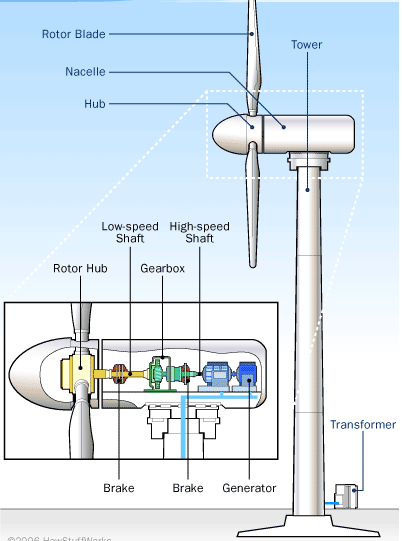
Functions of major Parts of a Wind Turbine to generate electricity.
Wind is one of the fastest-growing energy sources in the world. When it comes to alternative clean power from renewable resources, wind power is expected to occupy the second-largest share of the market in the future after Solar. In this article, I have given an overview of the major parts of a Wind Turbine and their functions to generate electricity from wind.
Before we go into the working of the major Wind Turbine components to generate electricity let’s first take a look at the basic principle of how does a wind turbine work to harness energy from the wind.
Wind energy is a free, renewable resource. No matter how much is used today, there will still be the same supply of wind energy in the future. Unlike conventional power plants, wind plants emit no air pollutants or greenhouse gases. Even though the technology requires a higher initial investment than fossil-fuel-driven generators, the costs of wind generating systems are much more competitive with other generating technologies on a “life-cycle” cost basis because there is no fuel to purchase and operating expenses are minimal.
Evolution of Wind energy use
The journey of wind energy stretches back centuries, long before the modern wind turbine found its place on our landscapes. In earlier times, people relied on simple windmills to grind grain or pump water—think of the picturesque windmills of Holland or those scattered across rural England. These early devices harnessed wind energy for local, mechanical tasks, shaping daily life in agrarian communities.
Fast-forward to the late 19th and early 20th centuries, and we see the beginnings of wind being used to generate electricity, especially in remote areas where traditional power grids hadn’t arrived. Small wind chargers popped up on farms in America’s Midwest, offering a taste of independence from fossil fuels even then.
Today, the technology has advanced dramatically. High-tech wind turbines now operate on vast wind farms from Texas to Tamil Nadu, delivering electricity to millions—and on a scale unimaginable to our windmill-building ancestors. As innovation continues and the global embrace of renewables grows, wind energy’s role keeps expanding, evolving from humble beginnings to a cornerstone of the future’s clean energy landscape.
What is a wind turbine, and how is it different from traditional windmills?
At its core, a wind turbine is the modern-day descendant of the classic windmill—but with a high-tech twist. Where old-fashioned windmills once dotted the Dutch countryside or rural English farms, turning canvas sails or wooden vanes to grind grain or pump water, today’s wind turbines harness the wind for a far grander purpose: making electricity.
Unlike their predecessors, which converted wind’s motion directly into mechanical energy for local tasks, wind turbines use large, aerodynamic blades mounted atop tall towers to capture stronger, steadier winds high above the ground. As the wind turns these blades, the motion spins a rotor connected to a generator, transforming the air’s kinetic energy into electrical energy that can power everything from streetlights in Denmark to homes in the American Midwest.
So, while both windmills and wind turbines are powered by the same invisible force, what sets the modern turbine apart is its role in producing clean, renewable electricity at a scale and efficiency our windmill-building ancestors could only dream of.
How does a wind turbine work – the basic principle
Wind Turbines, which operate on a simple principle, generate electricity by harnessing the power of the wind.
The energy in the wind turns two or three propeller-like blades around a rotor (as shown in the picture above). The rotor is connected to the main shaft of the turbine. When the wind blows on the angled blades of the rotor, it causes the rotor to spin thereby converting the kinetic energy of the wind into mechanical energy. Since the rotor shaft is connected to a generator through a gearbox, when the rotor spins, so does the generator. The rotating generator converts the mechanical energy at the shaft of the turbine into electrical energy by using an electromagnetic field.
Let’s now look into the roles played by the major parts of a Wind Turbine to make the turbine work.
Major parts of a Wind Turbine and their functions
The working of the major Wind Turbine parts (shown in the diagram above) are detailed below to explain how wind turbines work to produce electricity:
The Nacelle
The Nacelle is the most important among all the parts of a Wind Turbine. It houses all of the Wind Turbine components including the generator, gearbox, and brake assembly.
The Nacelle sits on top of the tower and houses the low and high-speed shafts, the gearbox, the brake, and the generator. It also houses a Controller that receives data from an Anemometer, which measures wind speed, a Vane, which measures wind direction, a Pitch control system that controls the angle of the blades, and the Yaw drive, which controls the position of the turbine relative to the wind.
The wind vane on top of the Nacelle tells the controller where the wind is coming from. Wind direction determines the design of the turbines – whether upwind or downwind. The upwind turbines have the rotor in front of the nacelle facing the wind while downwind turbines have the rotor behind the nacelle and facing away from the wind.
The effect of the rotor orientation i.e. upwind or downwind has a dominating impact on the unsteady loads of the wind turbine system. When the wind changes direction, the Nacelle and the Rotor follow. The rotor should always be facing the wind in order to catch the wind properly.
The Yaw System: Keeping Turbines Aligned with the Wind
The yaw system plays a crucial role in ensuring that upwind turbines are always properly oriented to harness the maximum wind energy. In upwind turbine designs, the yaw drive and its motor work together to rotate the nacelle—the housing for all critical turbine components—so that the rotor stays pointed directly into the changing wind. This automated adjustment helps the turbine capture wind efficiently no matter which way the breeze shifts.
On the other hand, downwind turbines take a more passive approach. Thanks to their design, the wind naturally pushes the rotor to align itself away from the nacelle, making a separate yaw drive unnecessary. This simple, self-correcting feature reduces mechanical complexity but is less common in modern large-scale wind farms, where precise alignment and efficiency are prioritized.
The controller of the wind turbine will always make sure that the rotor is turned into the wind. Nearly all wind turbines are of an upwind design.
Functions of Rotor and turbine blades
The Rotor is among the most important parts of a Wind Turbine which converts the kinetic energy of wind to rotary-mechanical energy.
The turbine blades and the hub together form the Rotor of a Wind Turbine. Most turbines have either two or three propeller-like blades. The hub is one of the main Wind Turbine parts that connect the blades to the main shaft and ultimately to the rest of the drive train that transfers rotational mechanical power from the rotor hub to the electric power generator.
The rotor is connected to the main shaft of the turbine. The energy in the wind turns the turbine blades around the rotor, which spins the power generator and the generator converts the mechanical energy at the shaft of the turbine into electrical energy by using an electromagnetic field. Thus the role of the turbine rotor practically explains, how a Wind Turbine generates electricity.
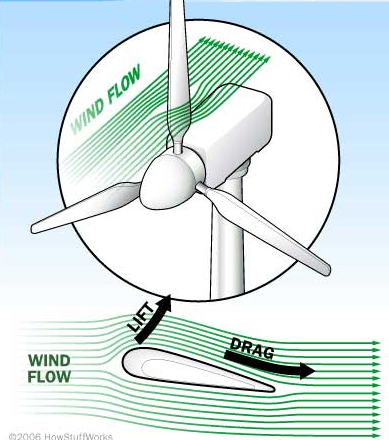
Function of the turbine blades
Direct-Drive Rotor Bearing
In direct-drive wind turbines, the rotor bearing plays an essential role in keeping everything running smoothly and efficiently. Unlike traditional turbines that use a gearbox, direct-drive systems connect the rotor directly to the generator, which makes the bearing’s job even more critical.
The rotor bearing’s primary function is to support the main shaft, ensuring it stays properly aligned as the massive rotating blades transfer energy from the wind. Because the entire weight and force of the spinning rotor are focused through the main shaft, the bearing must reduce friction between moving parts. This minimizes wear and tear, helps prevent potential damage to the shaft, and prolongs the lifespan of the turbine.
Put simply, the rotor bearing enables the main shaft to spin freely, bearing the brunt of the mechanical forces passed from the blades to the generator—helping the turbine efficiently convert wind into electricity.
The turbine blades work by generating lift and drag due to their difference in shape when the wind blows over them, like an airplane.
The two primary aerodynamic forces that work in wind-turbine rotors are ‘lift’, which acts perpendicular to the direction of wind flow, and ‘drag’, which acts parallel to the direction of flow. The blades of a wind turbine are shaped with one side (rear) much more curved than the other side (front). This varied shape causes a pressure differential when the air moves across the blades. The low-pressure air pocket on the downwind side of the blade pulls the blade towards it, causing the rotor to turn, which is called lift. The wind’s force against the front side of the blade is called drag.
The force of the lift is actually much stronger than the wind’s dragging force. The net result is a lifting force perpendicular to the direction of flow of the air over the turbine blades which creates torque in the Wind Turbine rotor and causes it to spin like a propeller.
Blade Materials and Sizes
Most wind turbine blades are constructed using fiberglass, favored for its light weight and impressive strength—a combination that allows blades to stretch to impressive lengths without buckling under wind pressure. Some manufacturers also incorporate materials like carbon fiber in certain designs to achieve extra stiffness and reliability, particularly in the largest turbines.
When it comes to blade size, modern land-based wind turbines typically sport blades over 50 meters (about 170 feet) long. Offshore wind turbines, with fewer limitations on space and transportation, have pushed this even further—blades now can extend well past 100 meters, rivaling the length of a football field. Thanks to this scale, the turbine is able to harness more wind energy with every rotation, further boosting overall power generation.
Functions of the main shaft
The low-speed shaft, which is the main shaft of the turbine, has important functions. It supports the rotor (hub and the blades) and drives the high-speed shaft connected with it through the Gear Box which is one of the major parts of a Wind Turbine.
The low-speed shaft transmits the rotary motion of the rotor and the torque momentum to the high-speed shaft through the Gear Box to drive the generator. Typically, this shaft rotates at a relatively slow speed—about 8–20 rotations per minute—providing the necessary torque to be increased by the gearbox.
To ensure smooth operation, the main shaft is supported by a main shaft bearing. This crucial component reduces friction between moving parts and prevents the forces from the rotor from damaging the shaft itself, allowing for efficient and reliable transfer of rotational energy throughout the drivetrain.
Main Shaft Bearing and Drivetrain Components
Part of the drivetrain, the main bearing supports the rotating low-speed shaft and reduces friction between moving parts so that the forces from the rotor don’t damage the shaft. This bearing is essential in ensuring the smooth transfer of energy from the rotor to the rest of the system, prolonging the lifespan of these critical components.
Lubrication and Maintenance Essentials
Like any piece of sophisticated machinery, wind turbines rely on regular lubrication and diligent maintenance to keep everything spinning smoothly. The moving parts—especially in the main shaft, gearbox, and generator—depend on specially formulated lubricants for optimal performance and minimal wear.
Lubricants:Critical components, such as the main bearings and gearbox, typically require high-quality oils and greases. Gear oil, engineered to endure both high torque and fluctuating temperatures, is commonly used in gearboxes. For bearings and pitch mechanisms, lithium-based or synthetic greases are favored to ensure reliable motion and rust protection.
Filters:Oil and air filters trap debris and contaminants, safeguarding sensitive parts from unnecessary abrasion and ensuring a consistent flow of lubricated oil through the system. These filters need periodic inspection and replacement.
Routine upkeep extends beyond just topping up lubrication. Regular maintenance tasks usually include:
- Lubricant Replenishment: Checking and refilling oils and greases at prescribed intervals to prevent metal-on-metal contact.
- Filter Replacements: Swapping out used filters to maintain clean systems.
- Inspection and Repairs: Conducting detailed inspections to spot wear, leaks, or misalignments, and replacing components—be that worn bearings, seals, or, occasionally, damaged rotor parts.
Qualified technicians handle these intricate jobs, following manufacturer-specified schedules to maximize both performance and service life of the turbine. Consistent attention to lubrication and maintenance pays dividends, ensuring turbines keep harvesting the wind for years to come.
The role played by the Gear Box
The power from the rotation of the Wind Turbine rotor is transferred to the generator through the power train, i.e. through the low-speed shaft (the main shaft), the gearbox, and the high-speed shaft. The rotor of the Wind Turbine rotates at a relatively slow speed. With a gearbox, this slowly rotating, high torque power from the rotor is converted to high-speed, low torque power, which is needed for the generator connected to the high-speed shaft.
The Gear Box increases the rotational speed of the generator from about 15 to 20 rotations per minute (rpm) for a large, one-megawatt turbine to about 1,800 revolutions per minute which most generators need to generate electricity. In modern wind turbines, especially those rated around 1.5 megawatts, the gearbox is housed within the nacelle—a structure so sizable that some are larger than a typical house and can weigh more than 4.5 tons. This massive component is crucial, as it must withstand the tremendous torque from the slowly turning blades and efficiently convert it into the rapid rotation required by the generator. The robust design of the gearbox and nacelle ensures the reliable transfer of energy under varying wind conditions, making them indispensable parts of the wind turbine’s power train.
High-Speed Shaft and Generator
Once the gearbox has increased the speed, the high-speed shaft takes over. This shaft is directly connected to the generator. As the high-speed shaft turns, it drives the generator where copper windings rotate within a magnetic field, ultimately producing electricity. Some wind turbines use a direct-drive system, which eliminates the gearbox by connecting the rotor directly to the generator, but in most commercial turbines, the gearbox remains a crucial component of the drivetrain.
This seamless collaboration between the main shaft, bearings, gearbox, high-speed shaft, and generator ensures that the kinetic energy harnessed by the wind is efficiently converted into the electrical energy that powers our homes and industries.
How direct-drive generators produce electricity without a gearbox
While traditional wind turbines use a gearbox to ramp up the rotational speed needed by the generator, direct-drive generators take a different approach altogether. Instead of relying on a gearbox, a direct-drive system has its generator coupled directly to the rotor. This generator is designed with a wide ring of powerful permanent magnets arranged around its edge, which rotate along with the rotor blades.
As the rotor turns—at a relatively low speed, typically between 8 and 20 revolutions per minute—these magnets pass by fixed coils of copper wire, inducing an electrical current through electromagnetic induction. The advantage of this large-diameter setup is that it can generate significant electrical power even at the low speeds of the rotor, making the need for a high-speed gearbox obsolete. This simplified design reduces mechanical complexity, minimizes maintenance requirements, and often increases the reliability of the wind turbine’s operation.
Difference Between Direct-Drive and Gearbox Wind Turbines
While most traditional wind turbines use a gearbox to connect the slow-turning rotor to a fast-spinning generator, not all turbines follow this design. Some, known as direct-drive wind turbines, take a different approach—particularly in offshore installations where reliability is crucial.
In a gearbox-based turbine, the rotor turns the low-speed shaft, and that motion is amplified by the gearbox, increasing the rotational speed before it reaches the generator. The gearbox acts as a mechanical intermediary, boosting the speed from around 15–20 rpm (rotations per minute) at the rotor up to the 1,500–1,800 rpm that most traditional generators require to produce electricity efficiently.
Direct-drive turbines, on the other hand, skip the gearbox altogether. Here, the rotor is connected directly to a large, specially-designed generator. Instead of relying on gear ratios, these generators are built to produce electrical power even at low rotational speeds—the same speed at which the rotor turns (typically 8–20 rpm). This is achieved using a ring of powerful permanent magnets within the generator, which interact with stationary coils of copper to generate electricity as they spin.
This design has a few notable advantages:
- Fewer moving parts, which means less maintenance and a reduced chance of mechanical failure—particularly important for offshore wind farms like those dotting the North Sea, where access for repairs is costly and difficult.
- Increased efficiency, as the direct connection avoids the energy losses that may occur in gearboxes.
However, direct-drive generators are often larger and heavier since they must create sufficient power at lower speeds, so there is a trade-off in terms of size and material requirements.
In summary, the key difference is that a gearbox turbine relies on a gearbox to transfer and speed up the rotor’s rotation for electricity generation, while a direct-drive turbine produces power at the rotor’s own speed—trading mechanical complexity for a more straightforward, and often more reliable, design.
The role played by the Controller
To optimize the functionality of a Wind Turbine, a controller is used, which is one of the most important Wind Turbine parts.
The controller increases power production and limits the loads on the structural parts. The control system consists of a number of computers that constantly monitor the condition of the wind turbine and collect statistics of operation from the sensors. The controller continually optimizes the energy production based upon continuous measurement of mainly wind direction and wind speed. It starts up the machine at wind speeds of about 8 to 16 miles per hour (mph) and shuts off the machine at about 55 mph.
Turbines do not operate at wind speeds above 55 mph because the high winds may damage the turbines.
The braking system
The braking system is one of the important parts of a Wind Turbine. This system stops the rotor automatically when its rotational speed exceeds its cut-out point to prevent any mechanical or electrical damage. The primary braking system for most modern Wind Turbines is the aerodynamic braking system which stops the turbine in a matter of a couple of rotations. In addition, the aerodynamic braking system offers a very gentle way of breaking the turbine without any major stress, tear, and wear on the tower and the machinery.
Unlike car brakes, turbine brakes serve a distinct purpose. Rather than simply slowing down moving parts, a turbine brake is designed to keep the rotor from turning after it’s been shut down by the pitch system. Once the controller stops the turbine blades, the brake ensures they remain stationary—a critical safety measure, especially during maintenance or high-wind events. This added layer of control keeps the turbine secure and protects both equipment and technicians.
The function of the Generator
The Wind Turbine generator converts the rotational mechanical power generated by the rotor blades into electrical energy. The wind pushes directly against the blades of the turbine, which converts the linear motion of the wind into the rotary motion necessary to spin the generator rotor to produce electricity by using an electromagnetic field.
All Wind Turbines have certain characteristics related to wind speed. The generator (or alternator) will not produce output power until its rotational speed is above its cut-in wind speed where the force of the wind on the rotor blades is enough to overcome friction and the rotor blades accelerate enough for the generator to start generating electricity. Above this cut-in speed, the power output from the generator would rise as a cube of wind speed (i.e. if wind speed doubles, the power output increases eight times) until it reaches its maximum rated power output. If the wind speed continues to increase, the Wind Turbine generator would stop automatically at its cut-out point to prevent any mechanical or electrical damage.
The function of the Pitch system
The Pitch system in a Wind Turbine is a closed-loop drive system that controls the angle of the turbine blades by rotating them so that the blades use the right amount of the available wind energy to get the most power output, at the same time ensuring that the turbine does not exceed its maximum rotational speed. This maintains the turbine’s safety in the event of high winds, loss of electrical load, or other harmful events.
The role played by the Wind Turbine Tower
Wind Turbines are mounted on a tower to capture energy from the wind. The main body of the turbine sits on top of the tower and behind the blades. The tower of a Wind Turbine supports the Nacelle and the Rotor (the hub with three attached blades). The taller towers enable Wind Turbines to capture more energy and generate more electricity because the wind speed increases farther away from the ground and the wind blows more steadily at a higher atmosphere.
Typically constructed from tubular steel, these towers are designed for both strength and stability. They are usually assembled on-site in multiple sections—often three—to make transportation and installation easier. Not only does the increased height mean higher, more consistent wind speeds, but winds at elevations of 30 meters (about 100 feet) or higher are also less turbulent, which further improves the efficiency and lifespan of the turbine. This strategic elevation is crucial; it allows the Wind Turbine to operate safely and efficiently, taking full advantage of the wind’s energy while maintaining the structural integrity of the entire system.
Materials and Height Considerations for Wind Turbine Towers
Wind Turbine towers are most commonly constructed from robust tubular steel, offering the ideal combination of strength, flexibility, and resilience necessary to support the turbine’s weight and withstand the forces exerted by wind and rotor movement. In some smaller or prototype installations, you might also find towers made from concrete, hybrid (concrete base with a steel upper section), or even lattice steel, though modern utility-scale wind farms overwhelmingly favor tubular steel for its reliability and ease of assembly.
The height of a Wind Turbine tower is hardly arbitrary; it’s typically based on the rotor’s diameter—the distance the blades sweep through as they spin. A practical rule is that the tower height should at least match the diameter of the blades’ sweeping circle. This approach maximizes the capture of stronger, steadier winds found at higher elevations, as wind speed generally increases—and becomes less turbulent—the further you get from the ground. Taller towers, sometimes reaching 80–140 meters (roughly 260–460 feet), allow Wind Turbines to harness more consistent energy and improve overall efficiency, making them a crucial design choice in modern wind power systems.
The function of the Foundation
At the literal base of every Wind Turbine lies the unsung hero: the foundation. This solid structure anchors the entire turbine to the earth (or to the sea floor for offshore installations), ensuring everything above stays upright no matter how fiercely the wind wants to play. The foundation must withstand not only the constant pushing and pulling of the wind, but also the immense weight and torque produced by the spinning blades and tall tower.
Depending on where the turbine is installed, foundations take on different forms. On land, you’ll typically find giant reinforced concrete pads buried deep underground. Offshore, things get a bit more creative—foundations might use massive steel piles driven into the seabed, gravity-based anchors, or even floating platforms tethered with strong cables. No matter the design, the goal remains the same: keep the wind turbine stable and secure, so it can safely and efficiently transform moving air into usable power.
The role of substation for delivering wind power to the grid
Once electricity is generated by the wind turbine, it’s not quite ready to power your home just yet. The next step in the journey involves the substation—a crucial link in the wind energy distribution chain.
The substation functions as the translation point between the wind farm and your local electric grid. Here’s how it works:
- The electrical energy generated by the wind turbines initially travels through cables to the substation.
- At this station, transformers step down the high-voltage electricity produced by the turbines to lower voltages that are safer and more suitable for distribution.
- From the substation, the electricity is then transferred onto the main power grid, where it travels through transmission and distribution lines to reach homes, businesses, and facilities.
Essentially, the substation ensures that the clean energy captured by spinning blades is safely delivered to your community—providing the final handoff from the wind farm to the electrical grid.
Common Issues Affecting Wind Turbine Components
Despite their cutting-edge design and robust engineering, Wind Turbines are still susceptible to a range of issues over time—much like any complex machine exposed to the elements.
For starters, the tower and foundation can be prone to corrosion, especially in areas with high humidity, salty air near coastal regions, or where protective coatings degrade. Periodic inspections and preventative maintenance are essential to catch and address corrosion early to preserve structural stability.
Moving inward, the internal components—such as bearings, gears, shafts, hydraulic systems, and sensors—are subject to wear and tear from constant movement and fluctuating loads. If left unchecked, degradation in these parts can lead to inefficiencies or even system outages. Scheduled maintenance, thorough inspections, and lubrication (sometimes using products from major players like SKF or Mobil) help ensure smooth and reliable operation.
The turbine blades themselves face unique hazards. While they’re engineered to endure all sorts of weather, they’re not entirely invincible—lightning strikes, for example, can cause significant damage to blades. Fortunately, modern turbines are fitted with advanced lightning protection systems that help dissipate electrical surges safely. However, occasional severe strikes still require thorough inspections and, if needed, repairs to keep the blades in top shape.
Being mindful of these challenges—and staying proactive with maintenance—allows Wind Turbines to deliver clean, dependable power for years on end.
The importance of regular maintenance for Wind Turbines
Wind Turbines might seem like they’re quietly spinning away on their own, but there’s quite a bit of behind-the-scenes work required to keep them running smoothly. Regular maintenance is absolutely essential—without it, all the intricate gears, electronics, and moving parts inside the turbine could suffer from wear and tear, leading to unexpected failures or even costly downtime.
So, what does Wind Turbine maintenance actually involve?
- Scheduled inspections: Crews will usually take each turbine offline a few times a year to carefully inspect the main components—everything from the electronics in the nacelle to the integrity of the tower and foundation.
- System checks: Onboard controllers and safety systems are reviewed meticulously to ensure they’re responding to wind conditions and data inputs as intended.
- Mechanical upkeep: Bearings, shafts, gearboxes, hydraulic systems, and sensors are all checked for signs of wear, corrosion, or damage. Elements exposed to the harshest conditions—like the blades, which can take the occasional lightning hit—are closely inspected and repaired as needed.
- Lubrication and replacement: Moving parts require regular application of lubricants such as grease or turbine oil. Maintenance teams also replace filters and other consumables to ensure everything runs efficiently.
Proper routine maintenance ultimately extends the life of a Wind Turbine, maximizes its performance, improves safety, and minimizes the risk of unplanned outages. As the demand for wind energy grows, ensuring turbines are properly maintained is what keeps this clean source of electricity spinning, day after day.
Maintenance: Keeping Wind Turbines in Top Condition
Regular maintenance is essential to keep wind turbines running smoothly and efficiently for years on end. Typically, wind turbines are taken offline for comprehensive inspections two to three times a year. During these scheduled check-ups, trained technicians perform a range of crucial assessments and tasks.
Here’s a brief overview of the typical maintenance process:
System Checks: The computerized control system within the nacelle is tested to ensure it accurately monitors performance data and responds to changing wind conditions as intended.
Component Inspection: All major electronic components are examined for wear, corrosion, or potential faults. This includes sensors, shafts, gears, bearings, and hydraulic systems, each of which plays a vital role in the turbine’s everyday operation.
Structural Review: The tower and its foundation are checked for any signs of corrosion or structural stress that might require repair. Maintaining the integrity of these key parts extends the life and stability of the turbine.
Lubrication and Filters: Moving parts—such as gears and bearings—are lubricated, and filters are replaced as needed to minimize friction and prevent future breakdowns.
Blade Protection: The turbine blades are carefully inspected, particularly for any damage from lightning or severe weather. Modern protection systems lessen the risk, but vigilant monitoring ensures damaged blades can be repaired promptly.
Because turbine technology is intricate and specialized, only skilled professionals handle these inspections and repairs. Customized maintenance schedules—suited to each turbine’s age, location, and workload—help energy providers maximize reliability while minimizing downtime.
Through this thorough and regular attention, wind turbines can continue harvesting clean energy effectively and safely for decades.
Specialized Equipment for Wind Turbine Transportation, Installation, and Maintenance
Like assembling a giant Meccano set in the middle of a field, wind turbines require some truly remarkable tools to get from the drawing board to spinning quietly on a hilltop (or offshore platform). The sheer size and weight of each component means that specialized equipment is needed at every stage—transport, installation, and ongoing maintenance.
1. Transportation Equipment
Moving turbine parts isn’t quite as simple as booking a courier service. You’ll need:
- Blade transporters: These hydraulically adjustable trailers cradle turbine blades (often over 50 meters long), allowing for tight turns through country roads and winding mountain passes.
- Extendable flatbed trucks and tower transporters: These carry the hefty tower segments and massive nacelles, sometimes employing modular axle trailers to handle the weight.
- Specialized cranes for unloading: Massive crawler cranes or truck-mounted cranes are used to offload parts safely at the wind farm site.
2. Installation Tools
Setting up a turbine is as much a test of engineering as it is logistics. Among the must-haves:
- Heavy-lift cranes: These giants can reach over 100 meters in height and hoist components weighing over 100 tons. Liebherr and Manitowoc are well-known in this space.
- Blade lifting yokes: Custom-built frames securely grip turbine blades for hoisting and precise positioning atop the hub.
- Tower-climbing platforms and lifts: These raised work platforms or interior lifts allow technicians to access high-up work areas.
- Clamp and rotation tools: These stabilized clamps and electronic controls help rotate and position blades and hubs during assembly.
3. Maintenance Equipment
To keep turbines whirring without a hitch, the following gear comes into play:
- Crane-less blade exchange systems: For remote or hard-to-access sites, modular lifting systems allow blade swaps without bringing in massive cranes.
- Portable torque tools: Specialized wrenches ensure bolted connections are secure during repairs or part replacements.
- Inspection drones: Increasingly, drones equipped with high-resolution cameras are used to fly close and inspect blades and towers for damage.
- Mobile service lifts and rescue devices: For both routine inspection and emergencies, personal lifts and descender devices are vital for technician safety.
Because each installation is different—whether the turbines are perched in a coastal breeze or dotting the plains—equipment is often adapted to site conditions, blade geometry, and local weather. Thoughtful deployment of the right machinery ensures turbines get where they’re going, stand tall, and keep producing clean energy with as little drama as possible.
You may also like to read this post: Wind energy advantages and disadvantages
Frequently asked questions
Now that the major parts of a Wind Turbine and their functions have been explained to show how does a Wind Turbine work, let me also address some of the related questions often asked by people.
How does a Wind Turbine work when it is not windy?
If the atmosphere is not windy or if there is too little wind and the blades move slowly, the Wind Turbine may not produce any electricity. There is a ‘cut-in speed’ at which the turbine starts to produce electricity. Power output continues to grow as the wind speed increases.
Why do Wind Turbines have 3 blades?
Fewer blades in a turbine reduce drag. But turbines with two blades will vibrate when they turn to face the wind. The angular momentum stays constant in a turbine with three blades. This is because when one blade is up, the other two points at an angle, and the turbine can rotate into the wind smoothly.
What are the parts of a Windmill?
The major parts of a Windmill are – the Tower, Rotor, Nacelle, Generator, Blades, and foundation.
To elaborate, a wind turbine is made up of five main parts and several smaller components that all work together to capture and convert wind energy. These main components are:
- Foundation: The solid base that anchors the entire structure securely to the ground, ensuring stability even in strong winds.
- Tower: The tall structure that elevates the blades and nacelle to a height where wind speeds are optimal.
- Rotor and Hub (including Blades): The rotor consists of the hub and three blades, which are designed to capture wind efficiently. Three blades are standard because they balance performance, durability, and smooth rotation.
- Nacelle: This is the housing at the top of the tower that contains key mechanical components—including the gearbox and other control systems.
- Generator: Located within the nacelle, the generator is what actually converts the mechanical energy from the rotating blades into electrical energy.
Each of these parts plays a specific role in ensuring the windmill operates efficiently and safely, working together to harness the power of the wind.
How much energy comes from wind in the United States?
Wind power supplies about 6% of total U.S. electricity generation with an installed capacity of over 80 GW, which is enough to power 24 million homes.
You may also like to read the related post: How does Wind work as a source of energy
Conclusion
It is hoped that after going through the major parts of a Wind Turbine and their functions explained above there should not be any difficulty in understanding how does a Wind Turbine work to harness energy from the wind to generate electricity.
The working of the main Wind Turbine parts can be summarized as follows:
1. One of the major Wind Turbine components is its Rotor. When the wind blows on the angled blades of the turbine which are attached to the rotor, it causes the rotor to spin thereby converting the kinetic energy of the wind into mechanical energy;
2. The rotor is connected to the main shaft of the turbine. The rotor shaft is connected to a generator through a gearbox. The gearbox converts the low-speed rotation of the drive shaft into high-speed rotation fast enough to drive the generator and convert the mechanical energy at the shaft of the turbine into electrical energy by using an electromagnetic field;
3. The electric current produced by the generator flows through a cable running down the inside of the turbine tower;
4. A step-up transformer converts the electricity to a higher voltage so that it can be transmitted to the power grid;
Once the electricity has been increased to the proper voltage, it travels along transmission lines—these are the high-voltage wires that carry electricity over long distances from wind farms to where the energy is needed. Transmission lines help minimize power losses and efficiently deliver electricity across cities and regions.
The electricity then reaches a substation, where it is linked to the wider distribution system. Inside the substation, transformers convert the high-voltage electricity down to lower, safer voltages suitable for use in homes and businesses. This final stage ensures that the power generated from the wind turbine is ready for everyday use in our communities.
