How does geothermal heating work?
How does Geothermal heating and cooling work?
Geothermal heating and cooling system is one of the most efficient and environmentally friendly space heating and cooling systems available for residential and commercial buildings. In this article I am going to explain how does geothermal heating and cooling work. But before that let’s first see how does geothermal work and what is geothermal heating and cooling system?
What is geothermal heating and cooling system?
How does geothermal work? Geothermal works by using relatively constant temperature of soil or water located just below the earth’s surface (in the range of 45° to 65°F) to heat and cool our homes.
Why does the ground maintain a consistent temperature year-round?
Here’s something fascinating: while weather above ground can swing wildly—think scorching Indian summers one month and shivering winters the next—the earth just a few feet underground barely flinches. Why is that? It’s because the soil acts like nature’s thermal blanket. Every day, the ground quietly absorbs a generous amount of heat from the sun—about 47% of it, according to the U.S. Department of Energy.
This steady warmth is the secret behind geothermal heating and cooling systems. No matter where you live, once you dig just a few feet below the surface, the ground keeps a fairly constant temperature—typically hovering around 55°F (13°C) year-round. To take advantage of this underground calm, a geothermal system uses a network of pipes buried in the earth, often called a “ground loop.”
Through this loop, a solution of water and an environmentally safe antifreeze is circulated. Acting as a giant heat exchanger, this loop lets the system absorb or release heat as needed, tapping into the earth’s reliable energy reserve to keep our homes comfortable, regardless of what’s happening outside.
This consistent absorption prevents drastic temperature swings underground, so even if you’re sweating in July or bundled up in January, the temperature below the surface stays steady—usually ranging from around 45°F to 65°F (7°C to 18°C). This natural stability is what makes geothermal systems so effective: they tap into the earth’s reliable temperature zone, instead of battling unpredictable outdoor weather.
It uses a geothermal heat pump system to either add or remove heat for our end uses, such as for space heating, space cooling or for water heating. The US Environmental Protection Agency (EPA) and the Department of Energy recommend the use of geothermal heating and cooling as a green technology to lower both energy costs and our dependency on fossil fuels.
Now let’s see how does geothermal heating and cooling work.
How does geothermal heating and cooling work?
Geothermal heating and cooling system consists of three main parts – a geothermal heat pump, a series of ground loop pipes buried underground and a distribution system (a conventional duct system).
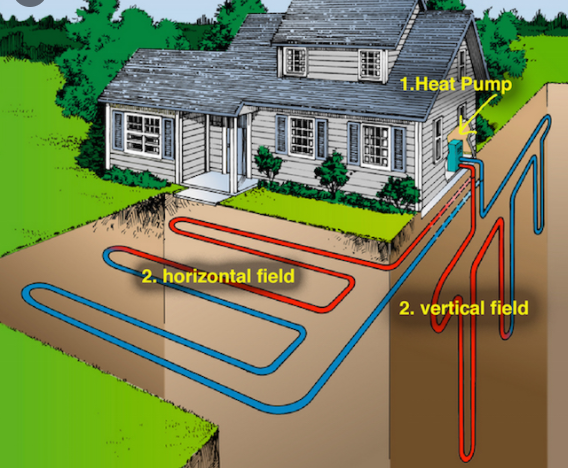
The heat pump unit is connected to a heat exchanger which has a series of ground loop pipes buried underground. The ground loop pipes are laid either in horizontal trenches below the ground surface if there is enough space or in a series of vertical boreholes which reach much deeper into the ground, where space is limited.
These ground loop pipes are typically made from small-diameter, High-Density Polyethylene (HDPE), a durable material designed to last for decades underground. The loop acts as the heart of the geothermal system, circulating a water-based fluid that absorbs or dissipates heat energy to and from your home.
Horizontal loops are used where there is adequate land—usually 1/4 to 3/4 of an acre is needed for a typical home. In this setup, trenches are dug using a backhoe or trencher, the HDPE pipes are placed inside, and the trenches are backfilled.
Vertical loops are ideal when land area is limited or the soil composition makes horizontal trenching impractical. In this case, boreholes are drilled vertically, and the loop pipes are inserted deep into the ground.
The type of ground loop—horizontal or vertical—depends on factors like available yard space, soil composition, and installation costs for your specific location. All loops serve the same purpose: harnessing the relatively constant temperature of the earth to efficiently transfer heat for both heating and cooling your home.
How do you determine which type of geothermal loop system is best for your home?
Choosing the right geothermal loop system for your home depends on a few important factors, and—just like picking between the subway and a tuk-tuk—what works for one property may not suit another. There are four main types of geothermal loop systems: horizontal, vertical, pond/lake, and open-loop (well-water).
Here’s a quick rundown on how you’d decide:
- Horizontal loops make sense if your property has plenty of open land and good-quality soil. If you’ve got at least a quarter to three-quarters of an acre to spare (like a typical backyard), this option is usually the most affordable.
- Vertical loops are ideal for homes with limited yard space or if the ground is too rocky or densely packed for trenching. Instead of stretching out, these loops dive deep—meaning they can squeeze into tight urban lots or rocky terrain where horizontal systems simply can’t go.
- Pond/lake loops work wonderfully if there’s an adequately sized (and non-freezing) body of water nearby. In this setup, loops are coiled and submerged in the pond, making use of the stable water temperatures for heat exchange.
- Open-loop systems draw groundwater directly from a well, using it as the heat exchange fluid. This method is popular in regions where water quality is suitable and there’s a sustainable source available year-round.
Ultimately, factors like available space, soil type, land features, access to water sources, and even local regulations—all play a role in determining the optimal system. It’s best to have a qualified installer assess your property and recommend the most efficient setup for your specific needs and location.
What’s the role of antifreeze in a geothermal loop system?
Now, you might wonder why the fluid circulating through those underground pipes often contains antifreeze along with water. Here’s the scoop: the antifreeze isn’t just for surviving Minnesota-like winters—it’s there to ensure the system can keep operating efficiently, even when soil temperatures drop below freezing.
By mixing in an environmentally-safe antifreeze, like propylene glycol or a methanol blend, the fluid inside the pipes remains liquid and keeps flowing smoothly, regardless of how cold it gets outside. This prevents the system from freezing up, which would halt heat transfer altogether and could even damage those tough HDPE pipes. So, the antifreeze solution works like a thermal lifeguard: it helps the loop system safely transfer heat to and from the earth year-round, protecting both your comfort and your investment in green technology.
The system takes advantage of the naturally occurring difference between the above-ground air temperature and the subsurface soil temperature to move heat from one point to another. The heat pump circulates a heat-conveying fluid (usually water/methanol mix) through the buried loop pipes that are in contact with the ground which allows the fluid to absorb heat from the surrounding earth or to remove heat from the warm air inside our homes for space heating or space cooling using a conventional duct system.
How can geothermal systems provide hot water for a home?
An added benefit of geothermal heating and cooling systems is their ability to help provide hot water for household use. Many geothermal heat pumps can be equipped with a special component—often called a desuperheater—that captures excess heat generated during the system’s operation.
This recovered heat, instead of being wasted, is redirected to your home’s water heater tank, preheating the water and reducing the energy needed to reach your desired temperature. In fact, during the heating season, the system can supply a substantial portion of your hot water needs at little or no extra cost.
For homes that require larger amounts of hot water—for example, if you have a big family or high hot water demand—some geothermal systems also offer dedicated water heating units. These units are designed to meet greater hot water requirements efficiently, making geothermal not only a great choice for climate control but also for improving overall energy savings throughout your home.
Now let me explain how does geothermal heating work.
How does geothermal heating work?
When the subsurface temperature is higher than the above-ground air temperature, the heat pump system moves heat from the ground to our homes via the circulating fluid through the buried loop pipes, effecting geothermal heating.
During this heating cycle the heat pump’s heat exchanger system pulls the heat from the fluid which is absorbed from the surrounding earth and distributes the heat as warm air throughout the house through the duct system. Thus the geothermal heating utilizes the earth as a heat source to obtain the heat. This is how geothermal heating works.
What makes geothermal heating different from other heating methods?
Unlike a conventional furnace that creates heat by burning fuel, or an ordinary air-source heat pump that must gather heat from chilly winter air (and becomes least efficient when you need it most), a geothermal heat pump (GHP) simply collects and moves the earth’s natural heat. It draws from the relatively constant underground reservoir, concentrates that heat, and transfers it indoors. This process is not only more efficient, especially during the coldest months, but also avoids the combustion process altogether—making it a cleaner and more sustainable solution for home heating.
How do geothermal systems compare to oil, natural gas, or propane furnaces in terms of efficiency?
When it comes toJ energy efficiency, geothermal heating leaves traditional oil, natural gas, and propane furnaces in the dust. Conventional gas furnaces—no matter how modern—are limited by the laws of combustion. Even the best high-efficiency gas furnaces top out around 98%, meaning a small portion of the energy in the fuel is always lost as waste heat.
Geothermal heat pumps work differently by moving existing heat from the earth, rather than creating it by burning fuel. For every unit of electricity that a geothermal system uses, it’s often able to deliver four to six units of heat—an effective efficiency of 400–600%. That’s a huge leap compared to fossil fuel furnaces.
The takeaway? By relying on the steady thermal energy underground, geothermal systems offer unmatched efficiency and can significantly lower both your energy usage and utility bills compared to conventional heating methods.
You may also like to read this post: Dual fuel Heat pump system
How does geothermal cooling work?
For geothermal cooling or geothermal air-conditioning of our homes, the heat pump system operates in reverse of as explained under how does geothermal heating work. Here’s how does geothermal cooling work.
Geothermal cooling works on the same principle as our refrigerator does. Our refrigerator removes heat from its interior and transfers it to outside in the room where it is placed. During the cooling cycle, instead of absorbing heat from the surrounding earth, the circulating fluid through the pipes absorbs heat from the surrounding warm air inside our home. Once the heat is removed from the surrounding air, the air becomes cool and the cold air is distributed all over the house through the duct system for space cooling or air conditioning. The heat absorbed by the fluid from the surrounding air, is ultimately deposited into the earth or water source that serves as the system’s heat sink, or receptacle for heat energy. Thus geothermal system utilizes the earth as a heat sink to discharge heat for cooling our homes in summer.
For this cooling process the geothermal heat pump system requires a small amount of electricity.
Geothermal Heat Pumps vs. Conventional Air Conditioners in Summer
Unlike traditional air conditioners and heat pumps, which release the heat from your home into the already warm outdoor air, a geothermal heat pump takes a more efficient approach. During the summer cooling cycle, the geothermal system moves the excess heat from your home’s interior and transfers it down into the much cooler ground via the underground loop pipes.
This process is more effective because the temperature underground remains consistently lower than the air outside, even during peak summer heat. As a result, it’s much easier for a geothermal heat pump to deposit the unwanted heat into the earth rather than fighting against hot summer air. This key difference is what makes geothermal systems significantly more efficient and reliable for cooling—even when the outdoor temperatures soar.
How does a geothermal system provide dehumidified air conditioning?
One of the lesser-known perks of geothermal cooling is its ability to deliver not just cool air, but comfortably dehumidified air as well. Here’s how that works: When your geothermal heat pump is set to cool mode, the system pulls warm, humid air from inside your home and passes it over the system’s indoor coil. As the air flows across this cool surface, moisture naturally condenses out—just like beads of water forming on a cold glass during a hot summer day.
This process removes excess humidity from your indoor air, making your living space feel fresher and more comfortable, even when temperatures outside climb. The cool, dry air is then circulated back through your home’s ducts, keeping you comfortable throughout the summer months. This added humidity control is another advantage over conventional air conditioners, which often struggle to maintain both temperature and humidity as efficiently as a geothermal system.
You may also like to read this post: Is Geothermal Energy renewable or nonrenewable?
Frequently asked questions
Now that I have explained how does geothermal work for heating and cooling our homes let me also address some of the related questions often asked by the homeowners, intending to install geothermal system.
How efficient is geothermal heating and cooling?
The circulating fluid in the buried underground loop provides geothermal heating and geothermal cooling at a remarkably high efficiency throughout the year. The conventional HVAC system (Heating, Ventilation, and Air Conditioning) is not that efficient because air temperature varies a lot throughout the year. Geothermal heating can be up to six times more efficient in producing heat energy as compared to traditional systems. The system uses about 15% less electricity than conventional systems.
To put this in perspective, while gas furnaces burn natural gas to provide heat and typically reach up to about 98% efficiency, geothermal systems take a different approach. Instead of generating heat by burning fuel, they collect and transfer existing heat from the earth—which means they can achieve efficiency ratings in the range of 400-600%. In other words, for every unit of electricity used to operate the system, you get four to six units of heating or cooling energy in return. This dramatic difference in efficiency is one of the main reasons why geothermal systems stand out as a reliable and cost-effective option for year-round comfort.
Although the geothermal heating system doesn’t get as hot as conventional boilers (regular boiler systems tend to operate at around 70-80°C whereas ground source heat pump systems normally operate at approximately 35-50°C) that doesn’t mean that you can’t get rid of the chill in winter if you have a geothermal system.
The geothermal heating and cooling system is designed to be highly efficient to maintain a comfortable temperature in your house or building throughout the seasons making your living environment more relaxing.
What are the benefits of geothermal heating and cooling?
Geothermal heating and cooling system has several benefits over HVAC system. Some of the key benefits of home geothermal system are as follows.
Environmentally friendly
Geothermal system is one of the most environmentally-friendly and safe heating and cooling system for our homes. It doesn’t burn any fossil fuel and produce almost no greenhouse gasses that contribute to air pollution. Only a small amount of electricity is used by the system. In fact, U.S. Environmental Protection Agency recommends use of geothermal air-conditioning and geothermal heating as a green technology to lower our dependency on fossil fuels.
Highly cost-effective
Although the installation costs of geothermal system is quite high as compared to the conventional HVAC system, you can potentially save a significant amount (up to 60% annually) with this system in the long-run from savings in your utility bills. According to the US Environmental Protection Agency, homeowners can save 40 to 60 percent on cooling and 30 to 70 percent per year on heating by installing home geothermal system. This means that the system pays for its installation in about 7 to 10 years.
In fact, geothermal heating and cooling systems are renowned for their impressive efficiency—often operating at 400% to 600% efficiency. This means for every unit of electricity used, four to six units of heating or cooling energy are produced. As a result, geothermal systems can reduce your heating, cooling, and even hot water costs by up to 70%. These remarkable savings add up year after year, making geothermal not only an eco-friendly choice but also a smart financial investment for your home.
Reduces dependency on fossil fuels
Geothermal heating system pulls heat from the earth’s core where an unlimited amount of heat is continuously produced naturally. Since the heat is obtained without burning fossil fuels, the energy source is sustainable and will not run out and can be re-used multiple times. Hence geothermal system can reduce our dependence on fossil fuels, whose supplies are rapidly running out.
Low maintenance costs
Since geothermal heating and cooling system has few moving parts compared to other HVAC systems, its maintenance costs are much less. It only requires periodic check up and very little maintenance as compared to conventional systems.
Long lifespan
The average lifespan of a geothermal heating and cooling system is about 24 years which can even be extended upto 50 years with little maintenance over the system’s lifespan. The only part of the system that may need replacement sooner than that (may be after 20 to 25 years) is the heat pump, which can be replaced at a fraction of installation cost of the full system. On the other hand the lifespan of a conventional HVAC system is much less, which is between 13 and 15 years.
What is the geothermal heating and cooling cost compared to HVAC system?
The geothermal heating and cooling cost is initially about 40 percent more than a conventional HVAC system due to high installation cost of the system. The current average installation cost ranges between $10,000 to $30,000 depending on available land, type of soil, local climate, the type of heat pump to be used and the amount of digging and drilling required. For larger homes, geothermal heat pump system can cost as much as $30,000 to $45,000. Nevertheless, although the initial cost for installing a geothermal system is quite high, due to considerable savings in annual utility bills, the system can pay for its installation in about 7 to 10 years depending on the utility rates and the cost of installation.
Is geothermal heating and cooling worth it?
Since geothermal heating and cooling is a highly efficient system, the homeowners can enjoy the benefits of significant savings on their utility bills and keep their homes at a comfortable temperature year-round by this system, in an eco-friendly way. You can save about 30 to 70 percent per year on heating and 40 to 60 percent on geothermal air-conditioning by installing home geothermal system.
Can I put geothermal in an existing home?
The geothermal heat pump system can be easily included in an existing system if there is enough space in your utility room or basement to accommodate all the necessary components.
How much land do I need for geothermal system?
You will need about 400 to 600 feet of horizontal loops for each ton of energy required for heating or cooling. A mid-sized house, which usually requires 3 tons of energy, would need land to accommodate approximately 1200 t0 1800 feet of ground loop pipes.
There are actually several types of ground loop systems that can be installed, depending on your land availability and site conditions:
- Horizontal Loops: Common for properties with enough space, these require trenches for the pipes and are typically used in residential installations.
- Vertical Loops: Ideal when yard space is limited. Deep holes are drilled vertically into the ground, which makes this option suitable for smaller lots or urban areas.
- Pond/Lake Loops: If you have access to a pond or lake, the loop can be submerged, making use of the stable water temperature.
- Open Loop Systems: These use well water as a heat exchange fluid that circulates directly through the system.
The type and size of loop system that’s best for your home will depend on several factors, such as the amount of available land, the type of soil, the climate in your area, and whether you have access to a suitable body of water. A qualified geothermal installer can help determine the most suitable and efficient system based on your property’s unique characteristics.
Does geothermal increases home value?
Since geothermal system saves significant amount on utility bills and helps in eco-friendly living, it can raise a home’s value. For example, with this system, the total savings may add up to $45,000 for a prospective buyer if he stays in his home for around 20 years.
You may also like to read this related post: Pros and Cons of Geothermal Energy
Conclusion
On going through how does geothermal heating and cooling work it would be evident that this heating and cooling system makes a great option for the eco-conscious homeowners. Geothermal cooling system is becoming increasingly popular in the US as people look for more efficient and environmentally friendly ways to keep their homes at a comfortable temperature year-round.
From the explanation of how does geothermal work it is apparent that it is more efficient when compared to traditional heating systems like furnaces, which have to burn fuels or use electricity in order to generate heat. Even in its cooling mode, the geothermal system is recognized for its efficiency.
As already explained in the post, the major factors behind the increasing popularity of eco-friendly geothermal heating and cooling system as an alternative to more conventional HVAC systems are – significant savings in energy bills, reduced maintenance costs, hedge against rising electricity prices and our reduced dependency on fossil fuels like oil and natural gas.
Environmental regulations are also giving more stress on the use of renewable energy sources in order to reduce carbon emissions and depletion of fossil fuels. This factor is also expected to have a positive impact on the increasing use of geothermal heat pump system for geothermal heating and geothermal air-conditioning of our homes.

Luke Smith
May 13. 2022
I am glad that you mentioned how geothermal systems got a lower maintenance costs compared to the HVAC system. We’re recently building a new house and before we could build the house proper, we’re thinking of laying out the foundation of the heating and cooling system first. I should probably ask for geothermal contractor services and have them help us with this project.
getworldclassservice
Jan 09. 2023
Geothermal heating and cooling system is environmentally friendly. In fact, it was recognized by the U.S. Environmental Protection Agency as the most environmentally-safe heating and cooling system.