The basics of Automated Controls.
An Overview of Automated Control Systems
I have in this article discussed the basics you need to know about automated control systems which boost efficiency and reliability in the applicable areas if used wisely and effectively. But before going into the subject first, we need to understand what is automated system and the basics of automated controls.
What is Automated System controls?
Automated control systems use feedback to regulate or control a process or device without human intervention to reduce inefficiencies and improve performance.
An automated system controls basically means a system control that uses technology to control different types of equipment and machines without the need for humans to interfere or manually perform the control in the production of goods and services. With reduced human assistance, automated control systems reduce production time, increase manufacturing flexibility, reduce costs and eliminate human error.
Modern advancements in various technology fields such as computer science (artificial intelligence and robotics), data-storage technology, software programming, sensor technology etc. have significantly contributed to the progress in automation
The aim of automated system controls is to boost efficiency and reliability. It increases the productivity of labourers and frees men from controlling systems that operate under conditions which are difficult to access or hazardous to health.
The basic elements of automation & control systems are,
1. Power: To accomplish the process and operate the automated system;
2. Program of instruction: To direct the process;
3. Control system: To actuate the instructions;
The Role of Instrumentation in Automatic Control Systems
For an automated control system to work its magic, it depends heavily on a network of clever instruments—think sensors, controllers, and actuators. Each of these plays a special role in making sure everything runs smoothly, efficiently, and more reliably than a room full of caffeine-fueled engineers.
- Sensors: These are like the system’s senses—constantly keeping an eye (or ear, or thermocouple) on conditions such as temperature, pressure, flow, or position. Without sensors, the control system would be “flying blind” and unable to react to changes in its environment.
- Controllers: Here lies the brain of operations. Controllers (be it a classic PID controller or something more advanced) receive real-time data from sensors and decide what needs adjusting. They follow the instructions provided in the program and figure out the exact output required to maintain desired setpoints.
- Actuators: These are the muscles. Actuators take their cues from the controller and physically change something in the system—opening a valve, adjusting a motor speed, or moving a robotic arm—so the process stays on track.
When all these components work together in a closed-loop system, they create a feedback loop: the sensors detect what’s going on, the controllers interpret the data and determine if something needs tweaking, and the actuators make those adjustments automatically. This tight coordination is what enables plants and industries worldwide—from automobile manufacturing in Detroit to food processing in the Netherlands—to run with such high efficiency. Instrumentation not only boosts productivity, but also makes it feasible to monitor and control processes in environments that would be risky or impractical for people.
With good instrumentation, automation isn’t just about replacing people—it’s about optimizing operations and making systems smart enough to handle complexities and disturbances all on their own.
The Importance of Mathematical Models in Automatic Control Systems
Now, you might wonder—what role do mathematical models play in all this automation wizardry? Simply put, mathematical models act as the “brains” behind many automatic control systems. These models represent the physical processes in mathematical terms, allowing control systems to predict, manage, and optimize complex industrial operations in real time.
Since no single catch-all model fits every process (one-size-fits-all is, sadly, still just a phrase), engineers often craft specific models for local applications—think controlling how materials are distributed inside a blast furnace or fine-tuning the timing for operations in smelting. These locally optimized models might manage everything from burden distribution to taphole operations or monitor specific process zones.
Once perfected, these smaller control strategies can be woven together inside a larger, hierarchical automation framework. This decentralized approach lets plant operators combine targeted expertise (from advisory expert systems or feedback-driven closed-loop controllers) into a cohesive, plant-wide network. The result? More reliable, less error-prone automatic control—upping productivity and safety while cutting down on operator guesswork.
What is a Programmable Logic Controller (PLC) and How Does It Work?
A Programmable Logic Controller (PLC) is essentially the brain behind many modern industrial automation systems. Picture it as a tough, industrial-grade computer—one designed specifically to keep working in environments that can be dusty, noisy, hot, or even prone to vibration. Unlike your standard desktop, the PLC is built for reliability on the factory floor.
PLCs are at the helm of operating machinery and processes, handling everything from conveyor belts in packaging lines to mixing operations in chemical plants. They do this by continually monitoring inputs—such as sensors, switches, or temperature gauges—and then executing a set of programmed instructions to control outputs like motors, valves, or lights.
One key feature of PLCs is their flexibility. You can program them to automate tasks using graphical languages, the most common being ladder logic. This visual approach was inspired by the old days of relay-based control panels, making it intuitive for engineers to transition from physical relays to programmable systems. Aside from ladder logic, PLCs can also use other programming standards like Function Block Diagrams or Sequential Flow Charts as needed.
PLCs are valued not just for their programmability but for their ruggedness and scalability. They are designed to tolerate electrical noise and even extremes in temperature—crucial in places like steel mills, automotive manufacturing plants, or food processing facilities.
Of course, like any electronic system, PLCs depend on inputs and outputs to function correctly. If a sensor wire breaks or a connection is lost, processes could halt, so routine testing and troubleshooting (often with a trusty multimeter) are essential for smooth operation.
Today, thanks to continuous development in technology and communications, PLCs can also connect with wider monitoring and control networks, such as SCADA systems, allowing for more sophisticated and centralized control than ever before.
With these capabilities, PLCs remain the go-to solution in a vast range of industries, from glass and cement production to automotive assembly lines, proving their indispensability in automated control.
Types of Automation Control Systems
There are basically two types of automation control systems – open-loop systems and closed-loop systems.
In an open-loop system of automated control the control action from the controller is independent of the process variable (output) whereas, in a closed-loop control system, the control action from the controller is dependent on the desired set value and the actual output value of the process.
Closed-loop controls are widely used in modern automated control solutions.
Analogue vs. Digital Control: What’s the Difference?
When it comes to automatic control in industrial settings, the choice between analogue and digital control systems can make all the difference in how precisely a process is managed. Let’s break it down—without the jargon overload.
Analogue control systems are the old faithfuls of the automation world. Think of them as traditional, using continuously variable signals (like voltages or currents) to represent changes in temperature, speed, flow, or other process variables. These systems are well-suited for simple control tasks or where smooth, real-time adjustments are a priority—such as controlling the position of a valve or the speed of a metering pump. However, analogue systems can be more vulnerable to electrical noise, signal drift, or interference, especially in busy factory environments.
On the other hand, digital control systems convert these real-world variables into discrete numeric values—using microprocessors or computers to interpret and act on them. This brings advantages like improved accuracy, advanced communication capabilities, and easier integration with other digital devices. For instance, a digital system may interface with sensors, process the data, and then provide highly precise control for mixing chemicals or batching ingredients in food production. Plus, digital controllers can effortlessly connect with larger supervisory systems, like SCADA, making remote monitoring and tweaking a breeze.
In short, while analogue controllers manage processes directly and smoothly, digital controllers excel at complex logic, data tracking, and integration with networked automation. Many modern facilities even use a hybrid approach, pairing analogue sensing with digital decision-making to get the best of both worlds.
Main Types of Automation Control Systems
To achieve these control strategies, three main types of automation control systems are commonly used: Programmable Logic Controllers (PLCs), Distributed Control Systems (DCS), and Programmable Automation Controllers (PACs). Each serves unique roles across various industries.
Programmable Logic Controllers (PLCs)
PLCs are industrial computers designed to withstand harsh environments and are primarily used to control machinery and processes in manufacturing plants. They handle both digital and analog inputs and outputs, and their reliability in environments with electrical noise and vibrations makes them a staple in industries such as automotive production, steel, and chemical processing. PLCs are most often programmed with ladder logic but can also use other languages like Function Block Diagrams and Structured Text.
Distributed Control Systems (DCS)
DCSs are ideal in situations where control needs to be distributed rather than centralized. Instead of relying on one control station, DCSs use multiple control loops throughout a plant, improving reliability and making it easier to monitor processes remotely. You’ll often find DCSs in chemical plants, oil refineries, and power generation facilities, where local control at various points enhances stability and efficiency.
Programmable Automation Controllers (PACs)
PACs blend the ruggedness of PLCs with the advanced capabilities of personal computers, offering more complex data processing and multi-domain control. They support a wider range of programming languages, including those commonly used in PCs, such as C/C++. PACs are frequently used in industries like food and beverage, water treatment, and oil and gas, where flexible and sophisticated automation is essential.
By selecting the appropriate control system—whether PLC, DCS, or PAC—engineers can optimize automation to meet the specific needs of a facility, from simple machine control to the complex, distributed processes found in modern manufacturing and processing plants.
What is a Distributed Control System (DCS) and How Does It Work?
A Distributed Control System, or DCS, provides a way to manage automated processes when having a single, central control point isn’t practical or reliable. Instead of all decisions and monitoring being handled from one location, a DCS consists of multiple controllers distributed throughout different parts of a plant or facility. Think of it as having various “mini-brains” stationed right where they’re needed—closer to the actual equipment—rather than relying on a single, all-knowing “mastermind.”
This architecture offers a few key benefits:
- Improved Reliability: If there’s a problem in one section, only that segment is affected, reducing the risk of the entire system coming to a halt.
- Ease of Monitoring: Operators can still oversee and supervise from a central terminal, but with the added advantage of localized control and faster response times.
- Scalability: As your facility grows, it’s easier to expand a DCS than to rework a centralized system. DCS systems shine in settings where processes are complex and highly interconnected, like chemical production, oil refineries, paper manufacturing, and power generation (including nuclear plants).
From a technical standpoint, a DCS links sensors, actuators, controllers, and human interfaces together through a local area network (LAN). These systems typically use standardized programming languages (like IEC 61131-3), and for certain applications—say, where concurrent tasks and distributed computing are critical—languages like Erlang may be favored.
Ultimately, the hallmark of a DCS is its focus on distribution: spreading intelligence and decision-making across the network. This helps minimize downtime, optimize performance, and provide robust control even in demanding industrial environments.
Unique Features of PACs and Their Programming Languages
What sets Programmable Automation Controllers (PACs) apart is their flexibility and sophistication—especially when it comes to programming options. Unlike traditional PLCs, PACs draw from both the well-established world of industrial control and the versatility of personal computing.
PACs are designed to support a wide range of programming languages. They typically offer the same languages used in PLC programming compliant with IEC 61131-3—such as Ladder Logic, Structured Text, and Function Block Diagram. But PACs go a step further: they often allow for additional, modern programming languages such as C and C++, which are more commonly found in personal computers and embedded systems.
This blend of industrial and PC-like programming environments provides several advantages:
- Easier Onboarding: Engineers and technicians familiar with general-purpose programming languages like C will find it quicker to adapt.
- Greater Functionality: Advanced features, robust data processing, and integration with existing IT systems become more feasible.
- Multidomain Control: PACs can manage tasks across several domains simultaneously—like process automation, motion, and data acquisition—all within one unified platform.
In a nutshell, the unique programming language support of PACs bridges the gap between factory floor automation and the broader world of modern software development, making automation systems not just powerful, but adaptable to future technological changes.
Principle and theory of Automated Control Systems
Automation control systems manage commands and regulate the behaviour of other devices or systems using control loops to achieve desired results. The scope of such automated control services ranges from a single home heating control system to large industrial automation control.
The three functional elements which are needed in automated control systems are,
1. Measurement;
2. Error detection;
3. Final control;
In closed-loop feedback control, the controller compares a measured output value of a process with the desired set value which is the reference or set point. The difference between the actual output value and the desired set value of the process is the error signal. This error signal is applied as feedback to generate a control action to make necessary changes in the input to the process so that the output value of the process stays at the desired set value despite disturbances. The closed-loop control can be diagrammatically represented below:
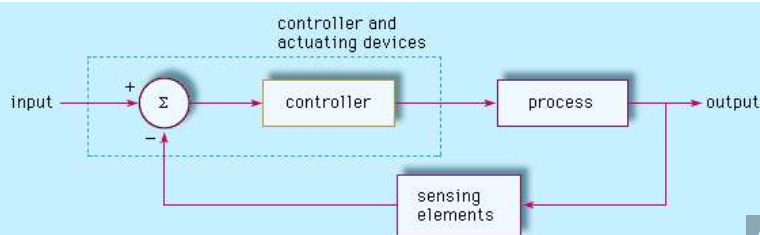
The output of the system is fed back through the ‘sensing elements’ for comparison with the reference value. The error signal i.e. the difference between the reference value and the output is then fed into the ‘controller’ to change the inputs to the ‘process’ under control.
How Automatic Control Systems Maintain a Set-Point
Let’s look at a practical example—say, keeping the liquid level in a storage tank constant, no matter how much liquid is entering or leaving. Here’s how the different parts of an automatic control system work together to achieve this:
- Sensing the Current State: A sensor or transmitter continuously measures the current level of the liquid in the tank. This sensor usually converts the physical measurement into a standardized signal (like a voltage or pneumatic pressure) that the control system can easily interpret.
- Comparing Against the Set-Point: The controller takes the sensor’s signal and compares it with the desired level, often called the set-point. The difference between these two values is the error signal. The controller’s job is to minimize this error.
- Calculating and Sending Corrections: Based on the size and direction of the error, the controller sends an output signal—again, usually following an agreed industrial standard—toward the actuator.
- Actuating Change: The actuator receives the controller’s output and physically adjusts the control valve or pump. For instance, if the liquid level is too high, the actuator may open the valve wider to let more fluid out, bringing the level back down toward the set-point.
- Continuous Adjustment: This loop runs continuously. The moment the level drifts from the set-point, the sensor detects it, the controller processes this change, and the actuator makes real-time corrections, all to keep the system stable.
This teamwork among sensors, controllers, actuators, and valves is fundamental to modern process automation, whether you’re managing a coolant tank, regulating steam flow in a power plant, or controlling pressure in a chemical process. By maintaining feedback and constantly adjusting, the system keeps the controlled variable—like tank level—right where it should be.
Managing Physical Property Changes with Automatic Control Systems
So, how do automatic control systems actually keep up when physical properties—like thickness, weight, or hardness—start to fluctuate during production? The secret lies in clever sensing, swift response mechanisms, and a few feedback tricks straight from the engineer’s playbook.
First, let’s consider the “set it and watch” approach. Operators dial in the desired specification (say, sheet thickness or material hardness) into the system’s control panel. Sensors and measuring heads then keep a vigilant eye (or electronic equivalent) on the process, continuously comparing live data against that target value.
When a deviation pops up—maybe the sheet gets a shade too thin, or the metal isn’t quite hard enough—the system springs into action. Depending on the complexity needed, the controller might:
- Apply a fixed correction only if the measured property drifts outside a preset tolerance (“dead-zone” control).
- Use a proportional correction, adjusting the process more or less depending on how far off the mark things are (“proportional” or “zone-proportional” control).
But it’s not just about making quick fixes. Advanced control systems add a few smart layers:
- Timing Units: These ensure the correction signal’s length relates to the size of the error—bigger mistake, longer correction. This helps address delays, like how long it takes a screw-down motor (think of those hefty motors in calenders or rolling mills) to spin up and actually alter the process.
- Interval Timers: To avoid jittery, over-corrective oscillations, these timers space out adjustments, factoring in how long it takes changes to travel through the process.
- Velocity Compensation: When product speed varies—as it often does on a busy line—additional sensors feed that information back to refine control timing, keeping responses sharp and steady.
For even more specialized needs—like changes in material properties affecting hardness in metal rolling or the compressibility of films—control systems integrate extra circuits or routines. These adapt dynamically, ensuring the process stays dialed in, regardless of fluctuating material behavior.
The bottom line? Through a mix of feedback loops, real-time measurement, adjustable correction logic, and timing coordination, automatic control systems make sure every sheet, roll, or batch emerges with physical properties right where they need to be—keeping plants productive and product quality on point.
What is a Programmable Automation Controller (PAC) and how does it compare to PLCs?
A Programmable Automation Controller (PAC) is a specialized digital computer designed to monitor and control industrial processes and automation tasks. While PACs bear similarities to traditional Programmable Logic Controllers (PLCs)—both can interface with sensors, actuators, and machinery—PACs offer enhanced capabilities, especially in terms of flexibility and advanced control.
A key distinction is that PACs are engineered to handle complex, multi-domain operations within a single, integrated platform. In practical terms, this means a PAC can oversee discrete, process, batch, and motion control applications simultaneously, whereas PLCs typically focus on one domain or a narrower set of tasks.
Another significant advantage of PACs lies in their software architecture. PACs support a broader range of programming environments. In addition to using the IEC 61131-3 standard programming languages (such as Ladder Diagram, Function Block Diagram, and Structured Text, familiar to PLC programmers), PACs often accommodate general-purpose languages found in desktop computing, like C and C++. This flexibility simplifies the adaptation process for engineers and technicians who already have experience with such languages, streamlining development and maintenance.
In terms of application, PACs are widely adopted in industries where control requirements are extensive and varied—such as automated manufacturing lines, food and beverage processing, petrochemical plants, and municipal water treatment systems. Their scalability and capacity to manage extensive input/output networks make them particularly useful where system integration and real-time data handling are critical.
By combining the robustness of PLCs with the openness and advanced processing power of modern computers, PACs help organizations achieve seamless automation across diverse and complex operations. This layered capability positions PACs as a versatile and future-ready choice for large-scale and evolving industrial environments.
Application of Automatic Control in Industrial Processes
In industrial settings, automatic control systems play a pivotal role in maintaining product quality and optimizing operations—especially in complex environments like deethanizer columns and blast furnace iron-making.
Take, for instance, a deethanizer column used in petrochemical processing. Here, automated systems use sophisticated simulation tools, such as Unisim Design, to model the entire separation process. This allows engineers to run sensitivity analyses, ensuring that when variables like feed composition or pressure shift, the controller can automatically adjust key operating parameters. By identifying dynamic relationships between inputs (like heating rates or reflux flows) and outputs (such as product purity), these systems fine-tune process set points using advanced feedback and feedforward strategies. The result is consistent control over product quality—even in the face of disturbances—without the need for constant manual intervention.
Similarly, in blast furnace (BF) operations, which are central to iron-making, the transition toward full automation has accelerated in recent years. Historically, many control systems provided operators with expert recommendations based on real-time process data. Modern closed-loop systems, however, take this further by directly managing vital process variables—such as burden distribution, hearth and taphole status, and airflow—minimizing the need for operator input. Each subsystem might rely on its own localized controllers or tailored mathematical models, and these are often integrated into a broader, multi-layered automation architecture. This hierarchical approach allows both targeted control over specific subsystems and overall plant optimization.
Through these layered and interconnected control strategies, industries can achieve higher efficiency, greater consistency in product quality, and safer operation—all while reducing the workload on human operators.
Major areas of application of Automated Control Systems
Find below some of the major areas of application of automation & control systems with examples, which need minimal or reduced human intervention:
1. Manufacturing – Controlling machinery and manufacturing processes, quality control, material handling and more. Application area also includes the use of industrial robotics that aids in various manufacturing processes;
2. Communication – Controlling electronic telephone switching systems to switch on telephone networks, communications satellites and automated mail-sorting machines;
3. Transportation – Besides control of automated guided vehicles, application areas include airline reservation systems, automatic pilots in aircraft and locomotives, and urban mass-transit systems;
4. Service industries – Applications of automated control services include health care, banking and other financial services, retail trade and more;
5. Home automation – Controlling household appliances and features in residential dwellings;
Advantages of Automatic Train Control Systems
Automatic Train Control (ATC) systems offer several significant benefits over traditional manual operation in modern rail networks:
- Automated Operation: Unlike conventional systems where a technician must manually oversee every aspect of train movement, ATC platforms allow for the programming of precise schedules and automated driving instructions. This results in smoother, more consistent operation and reduces the need for constant human supervision.
- Continuous Monitoring and Supervision: Manual oversight can sometimes delay the detection of faults or safety risks during a train’s journey. With ATC, real-time monitoring of the train’s status is possible, enabling quick identification and resolution of anomalies as they arise. This constant vigilance enhances operational reliability and minimizes the likelihood of undetected issues.
- Enhanced Safety and Protection: Trains are subject to a variety of operational hazards, from unexpected stops to equipment malfunctions. ATC systems automatically enforce critical safety protocols, such as maintaining safe braking distances and responding instantly to detected faults. This immediate protective response helps prevent accidents and minimizes the impact of unforeseen events on both passengers and infrastructure.
By integrating these advanced features, ATC systems play a crucial role in elevating both the efficiency and safety of rail transportation, setting a new standard compared to traditional manual control approaches.
Energy Management Through Building Automation Systems
Building automation systems play a pivotal role in optimizing energy consumption within modern facilities. By integrating with advanced technologies such as Variable Refrigerant Flow (VRF) controls, automation systems empower facility managers to seamlessly oversee energy use from both local and remote locations.
These systems typically provide intuitive graphical interfaces that make it easy to monitor usage patterns, set schedules, and adjust parameters specific to occupant comfort and operational needs. For example, a hotel can automatically regulate heating or cooling in guestrooms based on occupancy, ensuring energy is not wasted when rooms are unoccupied. Centralized software platforms, like those from Siemens or Honeywell, can aggregate data from multiple zones or buildings, allowing decision-makers to identify inefficiencies and take corrective actions from anywhere.
Additionally, building automation enables:
- Real-time monitoring of all connected devices and systems, flagging anomalies or excessive energy use immediately.
- Remote adjustment of HVAC, lighting, and other critical systems to respond to changing occupancy or weather conditions.
- Historical data collection and reporting to guide long-term energy-saving strategies and inform equipment upgrades.
Comprehensive Service and Support
Beyond the technology itself, the effectiveness of building automation relies on comprehensive service and support. Installations, programming, engineering, and ongoing maintenance are typically performed by dedicated teams with deep expertise in facility systems. A fully staffed commercial building service department can handle a broad spectrum of needs—from routine maintenance contracts and emergency repairs of HVAC control equipment to the upkeep of PLC control and energy management systems.
This professional support ensures that both new and legacy installations operate reliably and efficiently, minimizing downtime and safeguarding long-term performance.
Ultimately, by leveraging both on-site and remote management capabilities, building automation systems help organizations achieve substantial reductions in energy consumption, cost, and environmental impact.
Industries That Rely on Programmable Automation Controllers (PACs)
Programmable Automation Controllers (PACs) have become indispensable across a variety of industries where complex automation and data acquisition tasks are routine. Thanks to their advanced software capabilities—often blending PLC reliability with the flexibility of modern PC architectures—PACs effectively serve sectors with demanding control needs.
Typical industries utilizing PACs for their automation processes include:
- Manufacturing and Automated Production: Factories producing everything from automobiles to electronics leverage PACs for machine control, process optimization, and data logging.
- Food and Beverage Processing: The precise environmental control required in food and beverage production lines makes PACs an ideal choice for both quality assurance and regulatory compliance.
- Oil and Gas: Upstream and downstream operations, such as drilling or refining, require robust, flexible control systems; PACs excel in managing distributed assets and real-time process data.
- Water and Wastewater Treatment: Ensuring safe, consistent water quality and efficient treatment processes depends on the PAC’s ability to coordinate pumps, valves, and chemical dosing systems reliably.
In each of these fields, the scalability of PAC platforms, combined with their ability to integrate traditional PLC logic with high-level programming languages (like C/C++), enables facility teams to develop automation solutions tailored to their unique operational challenges. This adaptability is particularly valuable in environments where equipment and processes must evolve continuously to meet market and regulatory demands.
Key Considerations When Selecting an Automation Control System
When it comes to choosing the right automation control system for a facility, several crucial factors should be weighed to ensure a solution that aligns with both current needs and future growth. Each business or organization will have unique requirements, but the following considerations are essential for making an informed decision:
- Scalability and Flexibility: Evaluate whether the system can accommodate potential expansions or changes in facility layout and operation over time. Leading platforms like Honeywell or Siemens offer modular solutions that grow alongside your business.
Integration Capability: Consider how seamlessly the new system will interface with your existing infrastructure, including HVAC, lighting, security, and energy management systems. The ability to integrate with widely-used protocols (such as BACnet or Modbus) is especially important for centralized management and data sharing.
Ease of Use: Look for systems with intuitive graphical interfaces and remote-access capabilities, enabling staff to monitor, adjust, and troubleshoot operations without requiring deep technical expertise.
Reliability and Support: Prioritize systems backed by strong service networks, ensuring that installation, programming, and ongoing maintenance can be handled locally or remotely by certified professionals.
Cost Efficiency: Assess both the initial investment and long-term operational costs—including energy savings and potential reductions in manual labor or downtime.
Taking these factors into account, businesses can confidently select an automation control system that not only addresses immediate operational needs but also supports sustainable growth and ongoing efficiency improvements.
Applications and Industries Commonly Utilizing Programmable Logic Controllers (PLCs)
Programmable Logic Controllers (PLCs) are a cornerstone of industrial automation, chosen for their durability and flexibility across a broad spectrum of sectors. Their ability to operate reliably in challenging environments—where electrical noise, vibration, and temperature extremes are common—makes them especially valued in industries that demand minimal downtime and precise process control.
PLCs find extensive use in the following applications and industries:
- Manufacturing and Assembly Lines: PLCs are pivotal for managing complex production processes in factories, such as automotive assembly, electronics fabrication, and packaging plants. Their programmability allows adaptation to changing product lines or production requirements with minimal disruption.
- Steel, Chemical, and Petrochemical Plants: These facilities rely on PLCs for controlling intricate sequences involving pumps, conveyors, mixers, and valves. The systems oversee temperature control, batch processing, and safety interlocks, ensuring both efficiency and safety.
- Aggregate and Materials Processing: PLCs are essential in the mining and cement industries, automating tasks like sorting, mixing, and material transport, while delivering robustness against harsh environmental factors.
- Utilities and Infrastructure: Water treatment plants, power stations, and municipal waste facilities integrate PLCs for automating control of pumps, filtration systems, and energy distribution equipment, often interconnecting with SCADA platforms for centralized supervision.
- Glass and Food Production: In industries demanding strict quality and process consistency—such as glass manufacturing or large-scale food processing—PLCs reliably coordinate heating, cooling, mixing, and packaging operations.
- Transportation and Material Handling: From automated conveyor systems in logistics centers to intelligent traffic management or baggage handling systems at airports, PLCs orchestrate the seamless flow of goods and people.
Their adaptability, high reliability, and compatibility with modern software platforms have ensured continued relevance for PLCs, even as industrial controls have advanced. Whether operating legacy equipment or supporting cutting-edge automation, PLCs remain a fundamental solution across a wide range of commercial and industrial environments.
Industries Where Distributed Control Systems (DCS) Are Commonly Used
Distributed control systems (DCS) find widespread adoption in sectors that demand high levels of precision, reliability, and efficiency across multiple points of control. These systems are especially valued in complex environments where distributed intelligence enhances operational safety and reduces downtime.
Common industries that benefit from DCS implementations include:
- Chemical Processing and Petrochemicals: Plants handling continuous processes, such as chemical production and refining, leverage DCS technology to monitor and control intricate chemical reactions, ensuring consistent quality and safety standards.
- Power Generation: Facilities ranging from traditional fossil-fuel power plants to nuclear and renewable energy installations use DCS platforms for real-time monitoring, process automation, and critical safety functions.
- Oil and Gas: Refineries and upstream processing sites rely on DCS solutions for managing pipelines, separation units, and blending operations—all of which require synchronized, fail-safe controls.
- Pulp and Paper Mills: The paper manufacturing process, which involves continuous flows and multiple treatment stages, benefits from the distributed approach to minimize interruptions and optimize resource use.
- Water and Wastewater Treatment: Municipal utilities and industrial treatment facilities use DCS architecture to automate filtration, chemical dosing, and pump controls, supporting regulatory compliance and operational consistency.
- Pharmaceutical Manufacturing: DCSs are instrumental in regulated environments like pharmaceutical plants, where maintaining strict quality control across various production lines is critical.
International brands such as Siemens, Honeywell, and ABB have played significant roles in advancing DCS technology, making these systems a mainstay in industries where scalability and system integrity are non-negotiable.
By distributing control across local nodes and integrating with advanced sensor networks, DCSs help these industries minimize the impact of single-point failures and maintain continuous, dependable operations.
Programming Languages Used with PLCs
When it comes to programming programmable logic controllers (PLCs), a range of standardized languages and methods are available to suit different applications and industries. Traditionally, ladder logic has been the most widely used approach, designed to be familiar to electrical engineers by resembling the schematics of relay-based control systems. However, as automation needs have grown more complex, the selection of available languages has expanded to offer more flexibility and sophistication.
Common programming languages used with PLCs include:
- Ladder Logic (LD): The classic choice, ideal for discrete control and mimicry of relay logic.
- Function Block Diagram (FBD): Visual and modular, often used for process and batch control.
- Sequential Function Chart (SFC): Great for defining step-by-step processes and state machines.
- Instruction List (IL): A low-level, assembly-like language, now largely phased out but still found in legacy systems.
- Structured Text (ST): A high-level, text-based language enabling complex algorithms and data processing, similar in feel to Pascal.
These languages are standardized under the IEC 61131-3 standard, ensuring compatibility and familiarity across platforms from recognized brands like Siemens, Allen-Bradley, and Schneider Electric. While ladder logic remains prevalent in industries like glass manufacturing, modern PLCs are typically multi-lingual, allowing engineers to leverage whichever approach best fits their control challenges.
The Role of Service Departments in Supporting Commercial Building Controls
Service departments are crucial for keeping building automation and energy management systems operating at peak efficiency. Whether it’s a newly installed setup or an older legacy system, these expert teams handle a wide range of responsibilities to ensure reliability and performance.
Typically, their offerings include:
- Maintenance Contracts: Regularly scheduled inspections and proactive servicing of HVAC controls, PLCs, and energy management components help prevent unexpected breakdowns and optimize system longevity.
- Repair and Troubleshooting: Should an issue arise—be it a faulty sensor, erratic control response, or software glitch—service technicians respond swiftly to diagnose and resolve problems, minimizing downtime and disruption.
- System Upgrades and Optimization: As technology evolves, service professionals can retrofit and update systems, integrating new features or controls from providers like Honeywell or Siemens to further increase efficiency and ease of use.
- Continuous Support: Beyond one-off repairs, these departments offer tailored advice, help with system programming, and support for remote monitoring platforms, empowering facilities staff to maintain optimal control of building environments.
In essence, a capable service department safeguards the investment in automation technology by ensuring that buildings remain comfortable, efficient, and responsive to changing operational needs.
Maintenance and Repair Services for HVAC Control and Energy Management Systems
Ongoing maintenance and timely repairs are essential to keep HVAC control and energy management systems functioning at peak efficiency. Comprehensive service offerings are available for both newly installed and older systems, ensuring minimal downtime and optimal performance throughout the lifecycle of your equipment.
Typical services include:
- Scheduled maintenance contracts that cover routine inspections, system calibrations, and preventive care for controls and sensors.
- Diagnostic and repair services for HVAC control equipment, addressing everything from sensor malfunctions to communication errors within control panels.
- Support for Programmable Logic Controller (PLC) control systems, including software updates, troubleshooting, and replacement of faulty components.
- Energy management system checks to monitor performance, identify inefficiencies, and implement corrective measures when necessary.
By partnering with experienced service teams familiar with major platforms such as Siemens, Honeywell, and Johnson Controls, facilities can ensure all system components operate smoothly and reliably. Whether improving an existing setup or maintaining a cutting-edge installation, these services help extend the life of your equipment, safeguard occupant comfort, and sustain ongoing energy savings.
Why Quality and Expertise Matter in Building Control and Energy Management
Organizations today recognize that only the highest standards in building controls, energy management, and system integration will suffice—particularly when operations are high profile or mission-critical. Facilities that demand top-tier performance choose providers with a proven track record for quality, precision, and responsive support. This insistence on best-in-class solutions is not just about meeting expectations; it’s about exceeding them, ensuring every aspect of building automation operates at peak potential and reliably supports business objectives.
Advantages and Limitations of PLCs in Building Control Systems
Programmable Logic Controllers (PLCs) play a pivotal role in both industrial and commercial building automation, providing a reliable backbone for process control and system integration. Their design offers several distinct advantages, but there are also some limitations to consider when selecting the right platform for your facility.
Key Advantages
- Robustness and Durability: PLCs are engineered to operate reliably in challenging environments, tolerating electrical noise, vibration, humidity, and extreme temperature fluctuations—making them particularly well-suited for mechanical rooms, manufacturing floors, and utility spaces.
- Flexible I/O Handling: They accommodate both digital and analog input/output requirements, and are easily configured to interface with a wide variety of field devices, from sensors and relays to actuators and complex process instruments.
- Expandability and Integration: PLCs scale efficiently, supporting everything from small standalone control panels to complex networks distributed throughout a multi-building campus. They also integrate seamlessly with higher-level building management systems (BMS) and SCADA platforms via open communication protocols.
- Programmability: Traditional ladder logic programming—similar to legacy relay logic—remains intuitive for many technicians. PLCs can also be programmed using Function Block Diagrams, Sequential Function Charts, and Structured Text, offering flexibility for engineers accustomed to modern controls.
- Proven Reliability: With a longstanding track record in industries such as automotive, steel, chemical, and glass production, PLCs have shown superior uptime and predictable performance under continuous operation.
Recognized Limitations
- Programming Complexity: While PLC programming is powerful, it can require specialized knowledge, particularly when working with complex sequences or integrating modern programming languages. This sometimes necessitates advanced training for facilities staff or reliance on outside service professionals.
- Hardware Limitations: Entry-level PLCs may have limited memory, processing speed, or scalability. For expansive facilities or advanced energy analytics, other platforms—or hybrid solutions—may be more effective.
- Higher Initial Investment: The ruggedized nature and industrial capabilities of PLC hardware often result in higher upfront costs when compared to conventional DDC controllers or smaller-scale automation solutions.
- Maintenance Demands: Although reliable, PLCs require regular maintenance and testing of inputs/outputs to avoid unexpected process disruptions. Troubleshooting typically involves hands-on work with test instruments like multimeters.
Taken together, the choice to implement PLCs in your building control strategy depends on your facility’s specific requirements for durability, scalability, and integration. Many organizations opt for PLCs in applications where resilience and rapid troubleshooting are top priorities, but it’s important to weigh their strengths and potential drawbacks against the overall needs of your automation system.
Supporting Both New and Legacy Building Control Installations
A robust support structure is essential to keep both new and legacy building control systems operating smoothly. Many service providers accomplish this by maintaining a dedicated commercial building service team adept at handling a diverse range of tasks. Their expertise encompasses everything from routine maintenance agreements and technical troubleshooting to complete repairs, regardless of the system’s age or brand.
Whether working with state-of-the-art HVAC controls installed just last month or decades-old PLC-based energy management setups, these teams deliver:
- Scheduled preventative maintenance to ensure reliable performance and extend system lifespan
- Swift repair services for unexpected faults or component failures
- Optimization and calibration of controls to meet evolving operational needs
- Seamless integration and upgrades, drawing on platforms from leaders like Siemens and Honeywell
Behind these services is a multidisciplinary team made up of application engineers, electricians, service technicians, software programmers, and administrative support staff. This breadth of expertise allows for comprehensive coverage at every step—from initial installation and engineering through ongoing programming and responsive support. In many cases, installation and major repairs are handled in coordination with select electrical contractors, ensuring that even the most complex or large-scale projects are executed safely and efficiently.
By offering comprehensive support for both modern and aging infrastructure, organizations can rest assured that their automated systems continue to deliver efficiency and reliability without disruption.
Experience and Reputation of Leading Building Controls Providers
When it comes to building controls and energy management solutions, experience and reputation are paramount. The most respected firms in the industry typically bring decades of hands-on expertise—often having served commercial, institutional, and industrial facilities since the early days of computerized controls. Their longevity in the market reflects not only technical proficiency but also a proven ability to evolve alongside advances in automation, integration, and client expectations.
Reputable providers are known for delivering:
- Unwavering commitment to quality across all projects, whether integrating advanced Siemens or Honeywell platforms or servicing legacy automation systems
- A track record of meeting the stringent requirements of high-profile clients, where reliability, precision, and performance are non-negotiable
- Comprehensive support capabilities, spanning initial consultation and system design to responsive maintenance, upgrades, and emergency repairs
- An emphasis on long-term partnerships, understanding that continued trust depends on ongoing service excellence
Clients gravitate toward companies with this depth of experience because it ensures their building automation investments are in capable hands—delivering peace of mind, operational efficiency, and lasting value.
The Role of Expertise, Quality, and Service in Energy Management and Automation
In the energy management and controls industry, technical expertise, commitment to quality, and responsive service are foundational pillars that determine the success of any project or system deployment. Facilities today rely on increasingly sophisticated technologies—from Siemens Building Automation solutions to Honeywell’s integrated controls—to maintain comfort, efficiency, and resilience.
These core elements are not just industry buzzwords; they are the reasons some of the most demanding organizations consistently seek out top-tier providers for their building controls, energy management, and system integration needs. Whether managing a high-profile facility or a mission-critical environment, clients expect nothing less than the highest standards—and rightly so.
Why do these elements matter so much? For one, technical expertise ensures that systems are designed and implemented correctly from the outset, minimizing costly errors and downtime. Engineers and technicians with deep knowledge can seamlessly integrate new controls with existing infrastructure, troubleshoot unexpected challenges, and future-proof systems as technology evolves.
Quality, meanwhile, extends beyond the individual components; it encompasses robust system architecture, reliable performance, and long-term durability. Using proven equipment and adhering to best practices—from initial design and installation to ongoing calibration—reduces outages, preserves energy savings, and maximizes return on investment.
Finally, attentive service makes a world of difference over the lifespan of automated systems. Prompt support and proactive maintenance allow facility teams to address issues before they escalate, adapt to shifting demands, and ensure compliance with safety and energy regulations. In short, a partnership focused on expertise, quality, and service helps organizations realize the full potential of automation—improving comfort, lowering operating costs, and supporting sustainability goals.
You may also like to read this post: Robot control system – how do Robots work
Advantages and Disadvantages of Automation Control Systems
Advantages of automated controls
> Higher production rates and increased productivity;
> Efficient use of materials;
> Better product quality;
> Reduced factory lead times;
> Increases manufacturing flexibility;
> Reduces direct labour costs;
> Eliminates human error;
> Freed workers from the controlling systems can take up other roles;
> Improves safety of workers (reduces occupational injuries);
Disadvantages of automated controls
> Displacement of workers from jobs which are taken over by machines;
> Requires high initial investment due to high capital expenditure;
> High development costs;
> Requires higher level of maintenance as compared to manually operated machine;
What are the benefits of using a Distributed Control System (DCS) in industrial settings?
Distributed Control Systems (DCS) have become a mainstay in complex industrial environments for good reason, particularly when a single, central control station falls short. Let’s break down the key advantages that make DCS the preferred choice across sectors like chemical production, oil refining, and power generation.
1. Enhanced Reliability and Reduced Downtime
By distributing control responsibilities across multiple nodes close to the actual process areas, a DCS dramatically minimizes the risks associated with single points of failure. If one controller or processor encounters a fault, only a specific section of the plant is affected, allowing operations elsewhere to continue smoothly. This built-in redundancy helps avoid the all-too-familiar chaos of a total shutdown caused by a centralized system failure.
2. Streamlined Installation and Maintenance
Locating controllers near plant operations reduces the complexity and costs of wiring, installation, and future expansions. Troubleshooting also becomes easier and faster since system components are decentralized and typically modular, allowing technicians to address issues locally without disrupting the entire facility.
3. Scalability for Large, Evolving Operations
Unlike traditional PLCs, which often struggle with sprawling, multifaceted processes, DCS solutions are designed to scale. Whether integrating new production lines, expanding plant capacity, or adopting advanced process optimizations, a DCS can grow with your facility without expensive overhauls.
4. Improved Monitoring and Supervision
DCS platforms facilitate remote supervision and control, giving operators real-time visibility into every nook and cranny of the process. Centralized operator terminals bring together data from across the facility, making it easier to monitor trends, pinpoint faults, and make data-driven decisions.
5. Seamless Integration of Devices and Systems
Modern DCS solutions connect sensors, actuators, controllers, and operator interfaces over high-speed local area networks, building a robust ecosystem that supports quick data exchange and effective process management. This level of integration is especially valuable when working with standards like IEC 61131-3 and programming languages favored for their reliability and concurrent processing capabilities.
6. Versatility Across Industries
From the round-the-clock demands of petrochemical plants to the stringent safety requirements of nuclear power, DCS handles diverse industrial processes with precision and resilience. Its adaptability ensures that facilities can leverage the same foundational control philosophy, regardless of industry, scale, or process complexity.
Taken together, these advantages show why DCS is more than just a technological choice—it’s a strategic investment in consistent performance, flexibility, and peace of mind for any operation where uptime and efficiency matter most.
Frequently asked questions
Now that I have given an overview of the basics of automated control systems let me also address some of the related queries often asked by people.
What is an automated system?
The automated system is programmed to work automatically without the need for human intervention to provide inputs and instructions for its operation. The automated system operates with the help of the combination of both software and hardware.
Why do we use automated systems?
The automated system is used for higher production rates and increased productivity, more efficient use of materials, better product quality, reduced factory lead times and improved safety.
What are the advantages of automated control systems?
The main advantages of automated controls are that it helps to improve safety by reducing human errors, making the production process more efficient and reducing costs. This is particularly vital in industries such as agriculture and mining where there is a high risk of injury. Automation also enables shorter workweeks for labour.
Automated control systems are not just limited to manufacturing—they are making significant impacts in areas like energy management and sustainability. For example, many organizations now retrofit buildings with LED lighting and upgrade their Building Automation Systems (BAS) to monitor and control heating, cooling, and lighting more efficiently.
These efforts not only reduce utility bills but also help organizations move towards greener, more environmentally responsible operations.
What programming languages are suitable for DCSs?
When it comes to programming Distributed Control Systems (DCSs), flexibility and reliability are key. Most DCSs are configured using standardized IEC 61131-3 programming languages, which include options like Ladder Logic, Structured Text, Function Block Diagram, and Sequential Function Chart. These languages are widely used because they offer the necessary structure and modularity for complex automation tasks.
That said, some projects call for even more specialized tools. For larger, process-heavy industries—such as power plants, oil refineries, and chemical processing—engineers sometimes employ general-purpose languages known for robust concurrency and fault tolerance. Erlang, for instance, stands out in DCS applications for its ability to manage distributed, mission-critical control processes.
By leveraging these proven programming languages, DCSs can be adapted to handle everything from routine process automation to sophisticated real-time data monitoring, ensuring the system remains scalable and resilient as demands grow.
You may also like to read this post: Benefits of RPA – Robotic Process Automation Use cases
Conclusion
Higher output, increased productivity and reduced production costs are the biggest reasons justifying the use of automation control systems. Although automated controls may eventually override rather than serve humankind, it can yield substantial opportunities for the future, if used wisely and effectively. There is an opportunity to make work safer by relieving humans from repetitive and hazardous labour in all forms. The use of automated control systems would ultimately provide a growing social and economic environment in which humans can enjoy a better way of life.
Automated controls also extend their benefits to industrial operations, agriculture, and infrastructure. These systems are designed to optimize workflows, reduce energy consumption, and ensure consistent quality across various processes. Their comprehensive approach helps businesses not only meet but often exceed their productivity and profitability goals, while at the same time creating safer, more efficient, and adaptable workplaces. This holistic enhancement of operational efficiency and safety underscores the transformative role of automation in shaping a more productive and sustainable future for industries and society alike.

Saptarshi Ganguly
May 26. 2020
Great article on control automation!
radharenu ganguly
May 26. 2020
Hi Saptarshi
Thanks for stopping by and your comments.
IT
May 02. 2026
Good overview! it explains control automation as a system that uses sensors, logic, and control actions to manage machines automatically, making processes more stable, efficient, and less dependent on human input.
bbe